St. Vincent de Paul
1581-1660
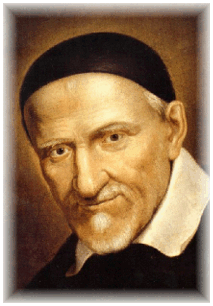
|
peasants
and the third of six children. At the age of 15 he began his studies
for the priesthood,
first at the Franciscan college in Dax and later at the He
was ordained in 1600 and received a degree in theology in 1604. Returning
from a trip to Marseilles in 1605, he was captured by pirates and sold
as a slave in returned
to Gondi,
general of the galleys and a member of one of the most powerful families
in France.
In 1617, while Pastor of Chatillon Les-Dombes, Vincent established his
first Confraternity
of Charity, composed of 20 women who volunteered to visit the sick and poor
of the parish. This organization is known today as the Ladies of Charity.
Near the end
of 1617, Vincent became chaplain to the 8,000 people who lived on the
Gondi estates. In
conjunction with this he began to minister to galley slaves waiting
in prison to be shipped
abroad. In 1619, King Louis XIII appointed him Chaplain General of the
Galleys. In
1624 he was asked by the Archbishop of Paris to found a community of
missionaries who
would travel through the country preaching and administering the sacraments
to the peasants.
This community was called the Congregation of the Priests of the Mission, better
known today as the Vincentian Fathers. Vincent
de Paul continued to establish additional chapters of the Confraternity
of Charity throughout
who
were more interested in raising money than ministering to the sick and
poor. Thus in 1633,
with Louise de Marillac, Vincent founded the Daughters of Charity, dedicated
to the personal
service of the sick and poor. Vincent
established hospitals and orphanages, ransomed Christian slaves in Northern Africa,
founded new seminaries to improve priestly formation, sent his priests
abroad to preach
missions, organized far-flung relief for victims of wars, and wrote
widely on spiritual
topics. Friend of nobility and royalty, his whole life was devoted to
the alleviation of human
suffering and misery. Vincent died in Paris on September 27, 1660. He
was canonized
by Pope Clement XII in 1737 and declared patron of all charitable organizations
by Pope Leo XIII in 1885. |